The Kingmaker’s Tail
or how AI broke the proxy that used to run reality

I. The Paradox of the Peacock
It was the year of our Lord 2019, and I was at La Residence wine farm in Cape Town, where wild peacocks roam the land. Did you know that peacocks don’t sound like birds? They don’t chirp. They sound like the protagonist of an M. Night Shyamalan movie being fed feet-first into an industrial wood chipper.
It’s highly unpleasant. Like, c’mon bro, I’m here with my wife, I’m tryna chill. Such a majestic creature; such an unholy abomination of a sound. I never knew. Which raises the question: why is this thing not dead?
I mean this literally, in the Darwinian sense. How could it be metabolically profitable to drag through the bush the biological disaster that is a peacock tail, while sporadically shrieking as you do? It is not an optimal survival strategy to have a six-foot iridescent fan strapped to your back when a tiger is chasing you. Evolution is supposed to be a ruthless optimizer, stripping away the wasteful and inefficient. And, yet, the tail persists.
To understand, we must invert: the tail is not beautiful despite being a metabolic burden. It is beautiful because it is a metabolic burden.
The peahen wants a mate with “good genes,” but genes are invisible. So she needs a proxy, a signal of value if you will. Any sickly beta-male can fake it if the proxy is cheap. For a signal to be credible, it must be so costly, so obscenely wasteful, that a low-quality faker would literally die trying to produce it.
Only a genuinely fit male can afford to drag that kind of F-you-money plumage through predator country and live to screech about it. The tail is proof of surplus. The waste is the message.
This is Zahavi’s handicap principle: a signal must be costly to credibly convey value.
Michael Spence applied the same thinking to Harvard and won a Nobel Prize. The value of the degree is not the education; it’s the signal to the market about a requisite threshold of competence and capacity to survive. Harvard stands as a proxy because an employer cannot measure capability in a 30-minute interview. The proxy works so long as it tracks the underlying characteristics and is costly to fake.
I am reminded of the tail every time AI does a thing, and I try to figure out: is this valuable?
II. What Even is Value?
I am a man, so I think of Rome. But I am also a venture capitalist, so I think of value. Specifically: how much value does this thing create?
It seems simple. It is not. For as it is surely written somewhere in the Talmud: what even is value?
A glass of water keeps you alive. A diamond sits on a finger and sparkles. Water costs almost nothing, and a diamond costs thousands of dollars. Which is more valuable?
This is Adam Smith’s diamond-water paradox. Smith said value came from the toil and trouble spent acquiring the thing. In other words, the labor. Diamonds are expensive because it’s a lot of work to mine them from the ground and cut them into carats. Water, by contrast, falls from the sky and is free. Value, in Smith’s telling, is congealed effort.
As he wrote in The Wealth of Nations, labor is “the ultimate and real standard by which the value of all commodities can at all times and places be estimated.” It is, he concluded, their “real price.”
This is the Labor Theory of Value. Karl Marx built an ideology on it, and that ideology, depending on which uncle is talking at Thanksgiving, is either the dawn of human dignity or a hundred million graves and a very bad century for Eastern Europe. The gist: if labor is the source of all value and the worker does the labor, then all wealth is theft of others’ effort, ergo, revolution.
And if I’m being honest, “labor is value” isn’t thattttt crazy an idea. I feel this in myself all the time. A canvas in the Guggenheim that an artist spent six months scraping and repainting until it finally got to a shade of gray that felt like anhedonia seems, to me, like art (dumb art, but certainly art). If you later tell me the painting was actually generated in 8 seconds with Nano Banana, and I’ve just spent 20 minutes looking at it, well, now I feel dumb, and it no longer feels like art.
You get the idea. Somewhere in these judgments is a story I’m telling myself about the maker’s calloused hands. We are all soft labor-theorists in our bones. None of us decides to be this way! It’s in the cultural programming. We tell our children to work hard, and they will do well. We look at a thing, eyeball the effort, and value rises in us like a tide.
The theory worked because hard-to-make things and worth-a-lot things were usually a close enough approximation of each other that you could use one to predict the other without running into too much trouble.
But anyway, labor theory does not solve the diamond water paradox. A bottle of water is worth vastly more when you’re hiking the Mojave Desert and are 600 feet from becoming a cautionary tale with a GoPro than when you’re at your desk in midtown. The water didn’t change. The situation changed. The same person in different contexts can have vastly different willingness to pay. Value, therefore, cannot be a property of the object itself.
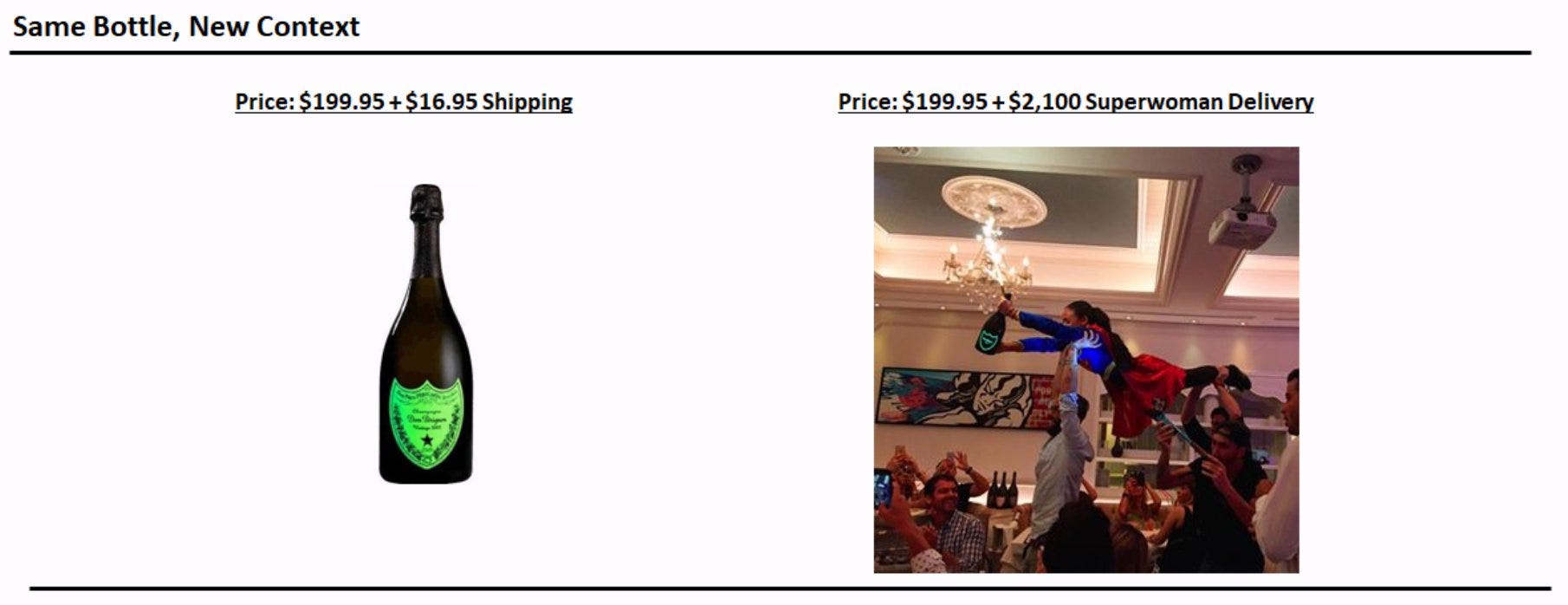
Same Bottle, New Context. A bottle of Dom Pérignon is $199.95 + $16.95 shipping online vs. $199.95 + $2,100 Superwoman Delivery at Bagatelle Brunch
Economists eventually solved this in the 1870s. Menger, Walras, and none other than our main man William Stanley Jevons! Yup, ladies and gentlemen, the very same Jevons whose eponymous paradox keeps coming up in the AI resource debate. Good ol’ Jevons! What a guy. Great family friend.
Anyway, they figured out that value is not a property of a thing and it is not the labor. Value is subjective, marginal, and ordinal: a relationship between a person and an object at a moment in time. Water is cheap because the marginal glass, the one after you’ve had your fill, is abundant and therefore useless. Diamonds are dear because they are rare at the margin and deep in the desire. They called this the Marginal Revolution, and Tyler Cowen writes a spectacular blog named for it.
But you cannot run an economy on “value is a fleeting relationship in the buyer’s heart that materializes at a moment in time.” Markets need a number, and value doesn’t have one. Cost, on the other hand, does. You can see it right there on the tag! So the official theory became marginalism, but the operating procedure remained, stubbornly, labor theory. The thing is worth roughly what it took to make it.
The only legible signal of willingness to pay was price, and the only legible signal of price was cost plus a markup. Cost became the waypoint on which everything navigated. This is why the cost proxy worked.
Which brings us back to the peacock! Zahavi taught us that genes are invisible, so the peahen reads the tail. Value, too, is invisible so the market reads cost and effort. Same trick, different jungle. It worked just fine for most of human history because difficulty was scarcity: the thing was scarce because it was difficult to make; the difficulty created the scarcity, and the wanting of the scarcity created the marginal value. Effort sat so close to value that nobody had to tell them apart.
III. The Caloric Theory of Value
The steam engine was built by men who believed heat was a fluid called caloric. You warmed things by pouring caloric in and cooled them by draining it out. We now know this is obviously wrong. Heat is not a substance; it’s molecular motion. But guess what!? It didn’t matter.
We industrialized 18th-century Europe with a model that is, at its core, a fiction. Caloric theory made enough correct predictions that questioning it seemed dumb. And it was useful! Kind of like how labor theory operating procedures were useful in KPIs and credentials even after marginalism won the academic debate.
We have an equivalent theory in economics. A Caloric Theory of Value, if you will. The theory states: the cost and effort of producing a thing are a reliable proxy for the value of the thing itself.
(Source: I made it up.)
You see it with legal advice or strategy decks where the work is worth whatever Wachtell or McKinsey charges. It’s endemic to sports: Jalen Brunson’s effort is worth $156M over four years. End states are worth the ordeal of their achievement. Cost stopped being a proxy of value and became a definition of it. “How much is it worth?” became “How much did it cost to make?”
And it worked! Because difficulty filtered reality. You didn’t write a 50-page brief unless someone paid you to do it, which they only did because they needed it. Cost was an embedded signal of seriousness. It was proof that real resources and real trade-offs had moved.
A proxy that holds for a long time seems like a “physical property” of reality itself. IQ feels like intelligence. The seven-day week feels like a fact of nature, not a social technology that won a standards war because enough people scheduled their prayers and public hangings around it.
You could do a lot with caloric theory. You could build steam engines or design a perfectly respectable blast furnace using caloric theory. But you could not invent air conditioning!


You also couldn’t invent nuclear power plants or rockets or lots of other things we have come to know and love. But mostly air conditioning, that Freon-kissed monument to American dynamism and the phylogenetic predecessor to “It’s time to build!”
First, somebody had to stop believing in caloric.
IV. The Lumen of Thought
How much does it cost to see? I don’t mean LASIK or that thing where they dilate your pupils and you blindly walk into the sun like a mole person. I mean the lumens hitting your retina.
In 1996, economist William Nordhaus showed that we’d been measuring the price of light by tracking the cost of things we set on fire, rather than the photons that arrive. Candles, whale oil, kerosene, gas, bulbs, glow sticks at the Coachella Yuma tent, fluorescents, LEDs. Add it all up, adjust for inflation, and official economic stats said light got three to five times more expensive since 1800.
The thing is, nobody wants dead whales. Nobody wakes up craving tungsten or whatever it was that Thomas Edison and JP Morgan traded in 1882. What they want is banishment of darkness. When Nordhaus recalculated in lumen-hours, which is the thing people actually want, the price of light fell by a factor of a thousand. Light became 99.97% cheaper. The CPI is a national institution. I’ve come to appreciate that national institutions can be conveniently off by one or two orders of magnitude, usually in the direction that favors the sitting incumbent in a California election. But not three.
Since we are on a roll coining neologisms, let’s affectionately call this one the Nordhaus Gap: the distance between the proxy and reality.
It’s the cost of candles vs. the value of light, the peacock’s tail vs. its genes. It’s the gap between what you want and what you can measure. The gap exists because we measure atoms, which are easy, and ignore value, which is hard. We built GDP, inflation, performance reviews, CPI–basically our entire economic edifice–on a system that systematically ignores what people actually care about.
Life inside the gap is quaint and comfortable. It’s basically the Shire: barely perceptible change, the candle’s price edging ever upwards, while Taleb’s turkey gets fed by hand, day after day… right up until Sauron shows up in a blood-caked apron and the Eye blinks PREHEAT COMPLETE. Surprise Hobbits! Welcome to Thanksgiving!
I’m mixing metaphors, but the point is that an input-based measurement system can see the candle getting costlier. It cannot see the candle becoming obsolete.
Input-based measurement systems track the resources and effort consumed in a process. Dollars, tokens, junior souls rendered into Jira tickets. Things like that. Whale oil, in the old framing.
What if we used an output-based measurement system? Track what is produced vs. consumed. Artifacts, revenue, strategy decks birthed into an indifferent world they do not know and that knows them not. These are lumens, in the light-generating parlance.
The problem is that even if you measure outputs perfectly, you still haven’t measured value. Value, as we established with the marginalists, is a state change in the world or person at a moment in time. A prompt to Claude Code is an input and the code it compiles is the output. But that output only creates value if it does a thing that someone cares about. An identical function that nobody ever calls has zero value, even if its outputs are pristine.
Nordhaus measured lumen-hours instead of inputs expended and got to fix his gap. If measuring outputs worked for Nordhaus, then why won’t it work for us? Because the lumen was sitting there the whole time, physical, countable, and indifferent to the day that the courage of men may fail, just waiting to be measured. There was a unit of light.
We would love to measure value instead of cost. So would everyone since the Sumerians first pressed accounting tablets into wet clay. But there is no unit of value, because value was never a property of the object.
There is no lumen of value. There is no lumen of the memo.
Nordhaus’s gap was good news the ledger missed. He corrected it, the price of light fell a thousandfold on paper, and everyone carried on living their lives.
V. The Human .zip File
“Why do you even have a job?” is a question the labor lawyers tell me I should stop asking.
Ronald Coase taught us that firms exist to minimize transaction costs. It’s too hard to pay a guy every time he tweaks a cohort analysis, so we pay him a salary to stand there and tweak whatever we tell him to. Fine. But Coase never told us why the job takes the shape that it does.
For that we need to use Coase on unhinged mode. We need to assume everything is a contract for minimizing transaction costs. If we do that, then, in the limit, biological indivisibility is just another transaction cost! And the “job” is a contract for minimizing exactly this cost.
The job is essentially a human .zip file. It contains a bundle of tasks: some have outputs that are easy to measure (like formatting slides), while others are incredibly expensive to measure (like judgment or stakeholder management). Some–like a sociopathic comfort with silence during an awkward pause in a negotiation, perfectly calibrated to the counterparty across the table–we may never be able to measure. It was impossible to price and verify each task individually, so firms bought the whole human bundle to average out the costs.
There was never a way to extract a specific capability you wanted without also subsidizing the erratic, emotional host it came packaged in. This host is a disaster. It needs sleep and food. It always – always – requests weekly one-on-one meetings. And it demands “culture.”
Human biology is a terrible substrate for software. It is a substrate of sorrow.
But throughout economic history, there was no alternative. If you wanted the cognitive output, you had to pay the biological tax. We had no other container for intelligence until GPT-4 introduced a synthetic substrate.
Suddenly, we could strip the intellect away from the mammal, and the moment that became possible, my LinkedIn feed broke into a moral panic. The standard narrative was: here is a job. The AI can now do the job. The human is replaced.
The traditional boundary for automation was skills-biased. Machines replaced repetitive tasks while complementing complex ones (Autor, Levy, Murnane, 2003). Factory workers were replaced; the guys on the Cipriani charity circuit were spared.
AI operates on an entirely orthogonal axis. It cares nothing for society’s line between blue-collar grind and white-collar grind-theatre, only for what is measurable versus what is not. Measurable means that a task can be codified into a set of rules or a score. A task can be automated the moment it crosses the fault line into the scored side.
This fault line is not static. As we get better at measuring things, we automatically get better at automating them, and AI is the greatest meta-measurement technology of all time. It actively expands the domain of what is measurable, including large swaths of what we call creative or innovative work.
“But hold on,” you say. “What about my job? My job requires intuition! I have tacit knowledge!”
Ah, yes. Tacit knowledge. The je ne sais quoi of the corporate world. Michael Polanyi once said, “We can know more than we can tell.”
Indeed, I’d wager that the thing everyone keeps calling “our company’s proprietary data” is, in good part, an agglomeration of our inability to articulate what we know. Beware the forward-deployed engineer that shows up with a notepad and a warm smile to ask how you do your job…
In the meantime, we are deploying sensors everywhere and digitizing more of life. I’m old enough to remember when a conversation between friends was “non-measurable” air. Now it’s a Granola wiretap you didn’t consent to, from a phone conveniently placed in that left-side chest pocket no one ever really knew what to do with.
We are extracting that tacit knowledge, bit by bit. Every Cursor suggestion accepted and every manual edit made to an output. When I yell, “Goddamnit, Claude! I said no em-dashes!“ I am speaking my truth. But I am also turning my vibes into vectors.
You think you are using the tool. My brother in Christ, you are data-labeling your replacement. You are Ship-of-Theseusing yourself, plank by plank, prompt by prompt.
Data Labeling Reality
This destroys the economic logic of the human bundle. It no longer makes sense to average tasks under a single salary when some remain stubbornly biological, and others become free to produce with AI. The measurable tasks become separable, and, therefore, tradable, and tradable tasks migrate to the cheapest available substrate. Squint at your org chart long enough, and your VP of Business Development starts to look a lot like a localized cluster of tasks…
AI does not have to substitute for the job. It just needs to decompose it by making enough of its components measurable. Then the human .zip file unzips, and the tasks are dumped on the table. Each one has to answer a question it never had to face alone: what are you actually worth?
The answer is no longer cost.
VI. The Verification Wall and the Death of the Proxy
The proxy that “worth roughly equals cost” is dead. Two problems emerge: a verification problem (how do you know the thing you’re buying is good?) and a consequences problem (how much does it matter if you’re wrong?).
We care most about cases when the stakes are high: when you can’t easily verify, and the consequences matter a lot.
If you buy a chocolate bar and it turns out to be bad, who cares? If you buy a surgery and it turns out to be bad, your next of kin cares very much. The necessity of verification is driven by this cost-of-being-wrong problem.
You may recall the used car “lemons problem” from Econ 101. George Akerlof showed that markets for things whose quality you cannot verify before purchase require institutional scaffolding to avoid collapse. It’s an information asymmetry problem that requires costly signaling to bridge. Institutions make the invisible visible in the form of an expense that someone must pay. Things like third-party verification, warranties, brands, regulation, etc. The market clears at prices that include this required verification cost.
While we are haggling over the used Honda Civic, note that we are all operating under bounded rationality (we are cognitively limited and make “good enough,” rather than perfect, choices) and face the constant threat of opportunism (people will happily scam us if given the chance).
AI makes both worse. It makes us more boundedly rational by flooding our attention and simultaneously increasing the surface area for opportunism and deceit. Both drivers rise together, and demand for verified trust, in turn, rises exponentially. Aashay Sanghvi, who backed Pangram (the bane of Thought Leader existence), noted that we are going to need investments in “cognitive security” just to combat the mental strain from the barrage of AI-generated content.
Historically, demand for verification was met naturally because cost functioned as a reliable proxy for value. Verification came for free because the mere existence of a complex artifact was self-verifying evidence of its worth. Human biology makes creation expensive, so no one wasted weeks of finite time producing a 50-page strategy deck unless it had real utility. The upfront agony was the vouching.
AI kills this proxy by decoupling creation from cost. We used to hire a Harvard grad for $250k to build a strategy deck. Now we spend a few cents of GPU compute for an LLM to hallucinate the same deck (granted, that hallucination may sometimes be a citation for a Supreme Court case that doesn’t exist, but we are getting there). The natural filter evaporates when a system can generate that same artifact for fractions of a cent. Proof must be bought separately, and that burden is dumped on the receiver.
Verification transforms from a free byproduct into a massive tax on human time. A recent paper by economists Christian Catalini, Xiang Hui, and Jane Wu maps out this “structural crisis.” The paper is excellent, and you should read the whole thing. It describes two racing cost curves: the cost to automate execution, which decays exponentially as compute costs come down, and the cost to verify outputs, which remains bottlenecked by human time and embodied experience.
Execution reaches the limit of human checking and keeps on marching happily along anyway. As the authors put it: “We become increasingly capable of generating output that we are decreasingly capable of verifying.”
AI shifts the bottleneck from intelligence to verification. And since AI sells outcomes, and outcomes carry risk, the philosophical business model of AI must eventually shift as well.
Software-as-a-Service will give way to Liability-as-a-Service. You will not pay for the generation of the work; you will pay for the institutional scaffolding that absorbs the liability if the work is wrong.
It’s already happening. Cognition just announced a Productivity Guarantee for its AI software engineer, and startups like AIUC are building the risk-transfer infrastructure needed to insure agentic work (Disclosure: I am not an investor in either, just a fan).


As intelligence becomes abundant and human verification bandwidth stays scarce, I am reminded of an old adage from the 90s about internet anonymity: “On the Internet, nobody knows you’re a dog.”
These days, nobody knows if you’re human.
VII. The Inverse Nordhaus Gap
Recall the shape of Nordhaus’s gap. He showed that we tracked candles and missed the light, so reality was better than the metrics said.
Now run Nordhaus backward. The dashboards of the agentic economy do not undercount value; they overcount it. Outputs are up and to the right, and we book it all as verified value because, under the old caloric theory of value, existence was proof. But now the artifact is free, and free things don’t vouch for themselves. So how much of this is actually valuable?
You can test this on yourself right now. Sometime this week, possibly today, perhaps even this hour, you received a document that no human wrote and no human read. It was dumped on your desk, and you were asked to “review ahead of the meeting.” Somewhere, a dashboard blinked green. It may be good or it may be worthless, but it is probably 20 pages of tight, font-size-9 prose that is now your responsibility.
Catalini et al. trace this runaway freight train to Goodhart hell: “Driven by the economic imperative to scale, unverified deployment becomes privately rational. Agents consume real resources to produce output that satisfies measurable proxies while violating unmeasured intent. As this hidden debt accumulates, it drives the system toward a Hollow Economy of high nominal output but collapsing realized utility, a regime where agents generate counterfeit utility.”
Counterfeit utility. That is the Inverse Nordhaus Gap! It is a hidden liability in the place where Nordhaus found a hidden gain.
It’s showing up in the telemetry. Google’s DORA research keeps finding that greater AI adoption is associated with lower delivery stability, even as throughput and perceived productivity rise. It looks like work, it feels like work, but it may not actually be work. This is Will Manidis’ “Tool Shaped Objects” thesis.
Congratulations, we are all in the business of verification now.
VIII. The Kingmaker
There’s a moment in the movie The Incredibles when the villain, Syndrome, explains his grand master plan. He is going to destroy superheroes by selling technology that gives everyone superpowers: “And when everyone’s super… no one will be.”
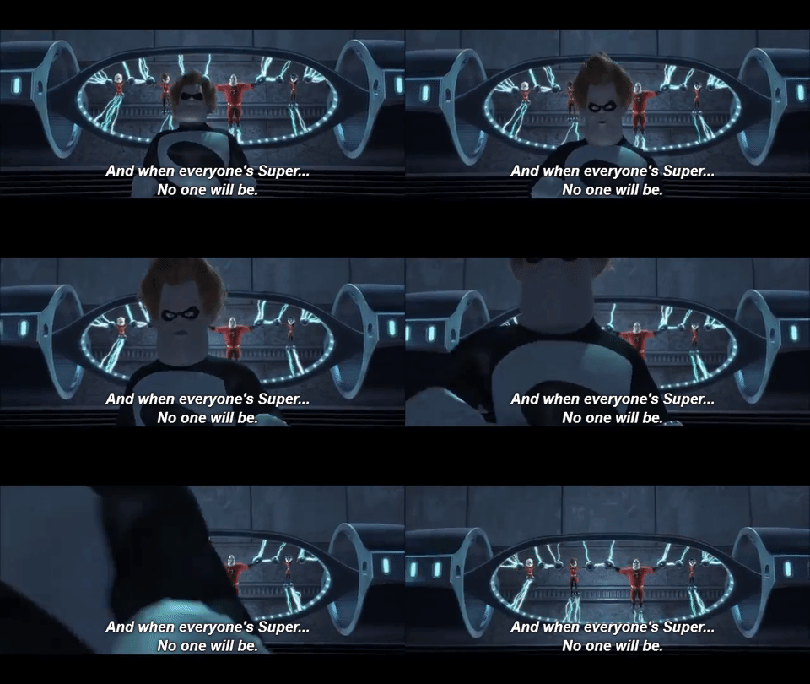
That’s the marginal theory of value wearing a cape! When you make something infinitely abundant, you make it worthless. A capability that used to make you special is now something that everyone is, which is to say nothing special, which is to say water.
So what isn’t water?
Since the measurable is being automated and the proxy for value is dead, we must look to the non-measurable and to where there is still some kind of unfakeable proof.
The first thing that comes to mind is Rick Rubin. He famously doesn’t play any instruments and has no technical ability whatsoever. He gets paid to point and say: “That one.” The pointing looks a lot like what we call taste — the ability to listen to 100 versions of the same song and know which is a hit.
But that can’t be it. If taste is just a matter of predicting hits, then an AI-generated song has already hit No. 1 on the iTunes charts, and the battle is lost. On closer inspection, when Rick Rubin points, two things happen:
His mind reaches into a deep well of pattern recognition, built over a lifetime, that reliably picks hits.
A new Schelling point emerges as many eyeballs watch and coordinate their behavior based on the pointing.
This transcends taste-based prediction. The pointing mints a new point in the distribution. Rick Rubin does not sit on the throne, but his endorsement puts someone there. He is the Kingmaker.
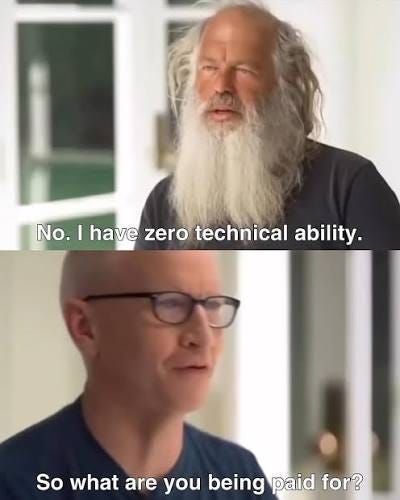
We can’t all be Rick Rubin, but we can try to generalize the formula that creates him. That formula is:
Stakes x Path = Kingmaker
Stakes is what you can irrevocably lose when you make a decision or take action. Reputation, career, freedom, fortune. Crucially, for a human, these are not abstractions—they are somatic. Losing your fortune is the physical terror of eviction. Losing your reputation is the evolutionary panic of exile. You can meaningfully stand behind a guarantee when you can meaningfully be ruined by its consequences. An AI agent does not have a reputation that bleeds when cut. Stakes are Zahavi’s handicap principle. The signal is credible because the signaler cannot afford to send it unless it is true.
Path is the non-compressible, irreversible history of life that was lived to produce the unique human standing in front of you today. Path cannot be trained. It is not a skill. It’s the continuous accumulation of singular experiences that calibrate your judgment. It’s those undocumented realities and shared moments that never live on a server. Path is non-transferable history.
Stakes and Path are interdependent. Stakes give weight to the actions that build Path; Path is what puts you in a position to have meaningful Stakes. You need both if you want a Kingmaker. Rick Rubin without Path is just a guy in a chair; without Stakes he’s just a critic giving a review. It’s the combination that creates the “pointing” authority.
Why is the Kingmaker safe from AI? Because it’s something you are, not something you do.
To make this more salient, consider the deathbed test: you are dying, and you must choose who sits with you. Option A is an AI therapist with perfect empathy but no Stakes and no Path. Option B is a well-meaning stranger who possesses Stakes (finite mortality) but no Path. Option C is a human being who has known you all your life and loves you, who will probably say the wrong thing, whose time on this earth is finite and who will also, at some later date, die.
Who do you choose? Everyone picks Option C. Option C is the ultimate multiplication of Stakes x Path. They are spending their finite, irreversible time just to sit in a room that offers nothing but the weight of your suffering, anchored by a shared history that cannot be faked.
The Path x Stakes = Kingmaker heuristic is obviously directional rather than definitive. You can poke holes in it. Persistent AI agents will develop Path, and you can capitalize them with $10 million and a smart contract to have Stakes.
But losing capital is a fundamentally different experience from losing your mind. An AI agent can lose a fortune without having a nervous breakdown, or waking up in a cold sweat or having their spouse file for divorce. Their loss is not linked to myocardial infarction. The bedrock of Stakes is the nervous system.
But biology alone just makes you a civilian. Any fool off the street can challenge Mike Tyson to a fight. Only Jake Paul, with his quirky and demented Path, can get Tyson to accept, and, in the accepting, drive record streaming numbers and a reported $60 million purse.
The Kingmaker is powerful because they are willing to lose and because they have built a self that is worth losing.
Which brings us, finally, to the kids.
“I thought what anybody would think in a situation like that: ‘Oh, my God. What is gonna happen to me?’” - Dave Chappelle, The Age of Spin (2017)
Path requires experience accumulated over time, so the kids are structurally disadvantaged. This is a topic for a whole nother essay–the Grimdark Adams’ Stack. Let’s put a pin in it for now.
IX. Standing Under the Arch
The Kingmaker is a load-bearing human. Rick Rubin absorbs the liability of the unknown when he points, underwritten by the non-transferable collateral of his lived experience.
Compute cannot cross this boundary because software precludes consequence. Don’t get me wrong, an agent can certainly cause irreversible damage— crash a self-driving car, drain a bank account, authorize a drone strike, etc.—but it cannot suffer irreversible blowback. Code can always be restored from a backup. Biology is strictly one-way.
Machines cannot die (note: this is a remarkably trite sentence to write, but oh well). They can price risk, but they cannot bear consequence. Liability always flows upward until it hits a nervous system. In that way, agents are a bit like corporations. You can sue a corporation, only to find another holding company behind it and another offshore entity behind that—it can be turtle after turtle after turtle on the way down—but eventually you reach a throat to choke. We need a throat to choke when the algorithm fails, especially when execution is free, and throats with Stakes x Path are in short supply.
To see how this operates, we must return to Rome.
In Ancient Rome, when an engineer finished building a stone arch, the law required them to stand directly beneath it as the wooden scaffolding was removed. The law did not ask a random civilian to stand under the stones because that proved nothing. It demanded the engineer—the human whose Path gave them the authority to build it, and whose Stakes guaranteed it wouldn’t fall. The engineer was crushed to death if the load-bearing math was wrong1.
Today, an AI can calculate the exact load-bearing stress of the arch better than the Roman engineer ever could. The cognitive capability of structural engineering is becoming a commodity. Soon, it will be water.
But the AI cannot stand under the stone as the scaffold is removed. It has no biology to be crushed.
In the end, to make sense of all this, we must invert, just as we did with the peacock tail. In an agentic economy, our biological substrate is not valuable despite its fragility; it’s valuable because of its fragility. It is the ultimate premium feature. We are the peacock dragging the weight of a mortal tail through a jungle of cheap, synthetic brilliance.
Earlier, I called human biology a “substrate of sorrow.” Our need for sleep, food, and emotional validation is a heavy tax levied on our cognitive output. We are a terrible container for software.
But we are the only valid container for consequence.
Cognitive labor loses its premium, the era of biological collateral begins, and the market stops paying us for doing the math.
It pays us to be a person worth standing under the arch.
Peace of mind receipt:
Sadly, I am told this story–which I read in Antifragile–is apocryphal.